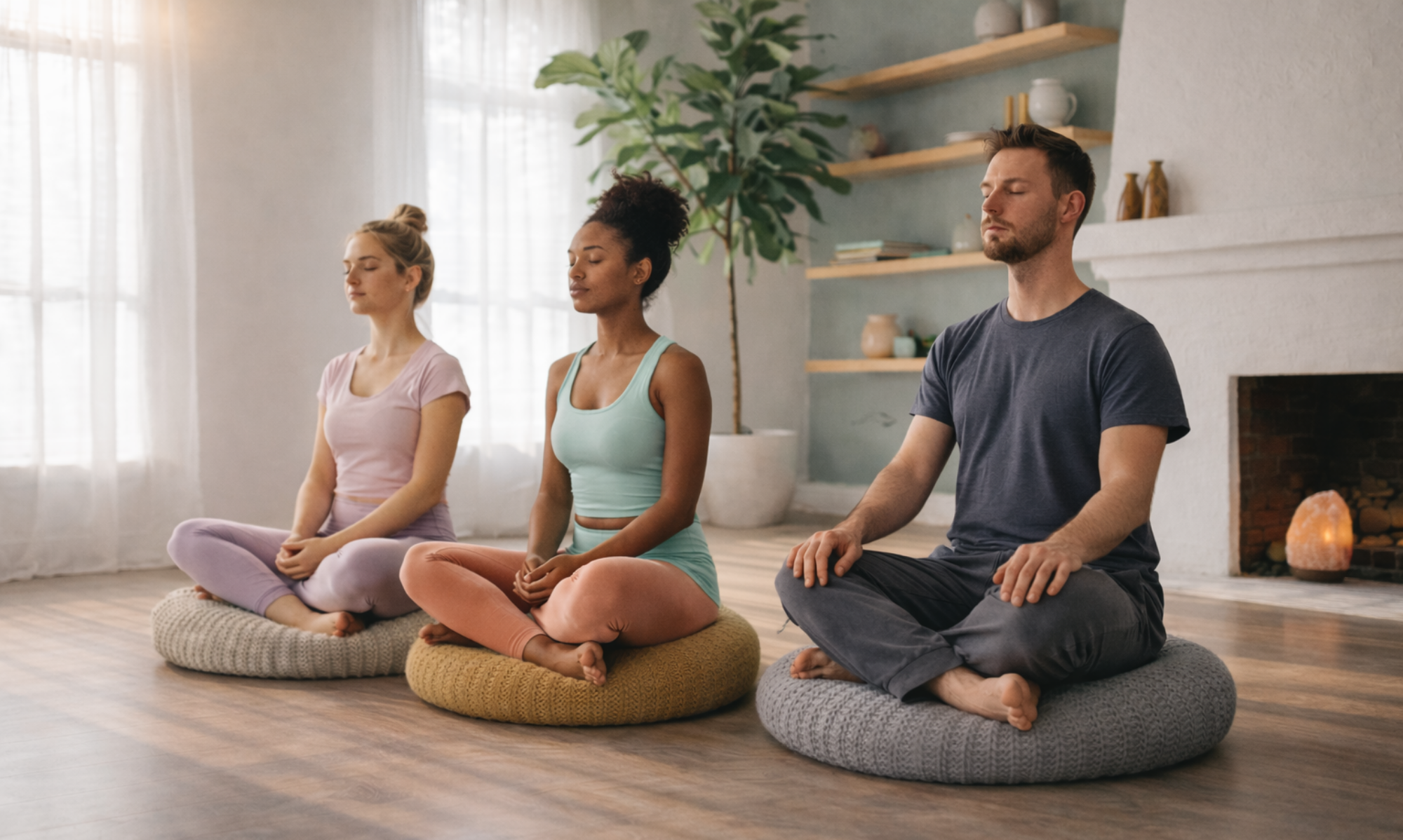

How Mindfulness Helps Parents Respond Rather Than React

What I’m learning from teaching mindfulness to families
One of the most powerful moments in teaching mindfulness is when a parent realises they can pause, right in the middle of a difficult conversation with their teen, and completely change the energy in the room.
I’m currently teaching an 8-week mindfulness course as part of a nationally funded research trial exploring whether mindfulness can support young people experiencing depression and anxiety. I work with parents’ and carers’ groups, helping them learn to bring ancient practices into modern family life.
Depression and anxiety can be extremely challenging for young people and their families. Offering mindfulness as a practical way to navigate the ups and downs of life feels like such a gift, and it’s inspiring to see how evidence-based approaches can blend with ancient wisdom to truly make a difference.
While the trial focuses on depression and anxiety, the principles we’re exploring are universal. Whether you’re parenting a teen with depression or anxiety or simply navigating everyday stress and overwhelm, the core skill is the same: learning to pause, breathe, and respond with awareness rather than react automatically.
“You can’t stop the waves, but you can learn to surf.” — Jon Kabat-Zinn
Learning to Pause
The young people who attend the programme already know that life can be hard and have tried one or more treatments that haven’t worked. They’re looking for something new, something that helps them meet life’s challenges differently.
The course doesn’t remove their stress, but it offers new perspectives, tools, and techniques to help them pause, breathe, and respond with awareness rather than react automatically.
Parents and carers learn similar skills in a parallel group that runs alongside the young people’s sessions, helping create a shared language and consistent approach at home. Everyone leaves with new skills, and often a new sense of hope.
What We’re Learning
During the course, we explore both the benefits and barriers of practicing mindfulness in daily life. We quickly discover that the point of mindfulness isn’t simply to relax (although that can be a lovely side effect), it’s to work skillfully with what life brings, especially when it’s difficult.
Cultivating the ability to pause helps us meet stress with more wisdom and compassion. One parent recently shared how the Three-Step Breathing Space helped them when their teen was distressed. Instead of reacting out of fear and trying to “fix” things, they paused, breathed, and listened. That small shift changed the whole energy of the conversation and the household.
Try It Now: The Three-Step Breathing Space
You can try this simple practice anytime you feel overwhelmed. It only takes a few minutes and can be done with eyes open or closed.
Step One: Become Aware
Notice what’s happening right now in your body, mind, and emotions.
Step Two: Focus on the Breath
Bring your attention to your breathing. Stay here for a few moments.
Step Three: Expand Awareness
Gently widen your focus to include your body, surroundings, and the moment you’re in. Return to your day with a new sense of perspective.
Want more practices like this one? Download my free guide — Simple Ways to Find Calm — simple mindfulness practices for everyday moments.
Taking It Further
This is just one of the many practices we explore during 8-week mindfulness programmes. The course structure gives participants time and space for deep learning and habit formation, mindfulness gradually becomes woven into the fabric of daily life, offering support when it’s needed most.
It’s inspiring to see the everyday transformations that unfold when ancient wisdom meets modern challenges. Mindfulness taught in an accessible, evidence-informed way empowers people to meet life’s stresses with greater calm, clarity, and compassion.
If you’re curious about bringing these practices into your own life:
Join me for a weekly drop-in meditation on Thursday evenings (6:15pm at St. Mark’s Hall, Barnet or online), it’s £5 and everyone’s welcome. I also offer one-to-one sessions for more personalised support.
Get in touch at ruth@pathwaytocalm.com.
Ruth McDonald is a BAMBA-registered mindfulness teacher. She teaches a weekly drop-in session and works with individuals and groups in London and online.
The benefits of mindfulness

Mindfulness brings many profound benefits. It significantly improves focus and reduces emotional reactivity. Participants often report better sleep quality and lower overall stress levels. Mindfulness is recommended by NICE, the UK’s National Institute for Health and Clinical Excellence, to enhance mental well being. Scientific research now evidences the benefits of mindfulness that have been known to practitioners for thousands of years. The research supporting mindfulness keeps growing. In the last year the equivalent of over 2 research studies were published every day.
Next Steps
To understand more about what mindfulness is, there is a short introduction here. If you are ready to take the next step on your own journey toward sustainable well-being. See my current offerings here or get in touch via email or phone to discuss the best personalised approach for you.
✉️ ruth@pathwaytocalm.com
📞 07432 140 102
Discover Mindfulness
Discover what mindfulness is and the proven research-backed benefits it can offer to you. Mindfulness is recommended by NICE, the UK’s National Institute for Health and Clinical Excellence, as a treatment for mental well being.
What are the benefits of Mindfulness?

✉️ ruth@pathwaytocalm.com
📞 07432 140 102
What is mindfulness?
Mindfulness is about being more aware of each moment – of yourself, others and the world around you – with a sense of openness and curiosity.
When we become more aware of the present moment, we begin to experience afresh things that we have been taking for granted. We start to experience the vitality of life.

“Mindfulness is about being fully awake in our lives.
It is about perceiving the exquisite vividness of each moment”
John Kabat-Zinn, creator of Mindfulness Based Stress Reduction
As we strengthen our capacity to become more aware, it helps us to understand ourselves better. We start to see our patterns of reaction and the possibilities of stepping out of these if we find they are not serving us. This frees us to navigate life with more ease.
Mindfulness draws on thousands of years of meditative traditions. There is also a considerable body of research that speaks of the effectiveness of mindfulness training in a wide variety of contexts.
Mindfulness is taught in corporations, schools, law courts, prisons, government agencies and the UK Houses of Parliament. Mindfulness is also recommended by NICE, the UK’s National Institute for Health and Clinical Excellence, to support mental well being.
“Now is the future that you promised yourself last year, last month, last week.
Now is the only moment you’ll ever really have.
Mindfulness is about waking up to this.”
Professor Mark Williams, one of the creators of Mindfulness Based Cognitive Therapy
Mindfulness is best learnt experientially.
Join our weekly meditation drop in or book a one-to-one session
✉️ ruth@pathwaytocalm.com
📞 07432 140 102
About Me
Mindfulness Teacher in London & Online

Hello, I’m Ruth — a mindfulness teacher and practitioner offering practical mindfulness support for stress and overwhelm, both online and in London.
My path to mindfulness
My journey with mindfulness began during a demanding business career, where I experienced first-hand the pressures and pace of modern life. Like many people, I initially turned to mindfulness as a way to manage stress and keep going.
What I found was a deeper, ongoing practice that gradually brought greater resilience, clarity, and ease. Rather than removing life’s challenges, mindfulness changed how I related to them, creating more space, perspective, and choice. This lived experience continues to inform how I teach mindfulness today.
How I teach mindfulness
I offer practical mindfulness teaching designed to support everyday life. My approach is grounded, accessible, and choice-led, focusing on simple practices that can be integrated into daily routines.
Mindfulness does not aim to eliminate stress or difficult emotions. Instead, it supports a different way of meeting experience, with greater steadiness, self-awareness, and kindness. Over time, many people notice improved emotional regulation, clearer focus, and a growing sense of calm and balance.
Professional training and ethical standards
My teaching is underpinned by strong academic training and professional integrity. I hold a Distinction in an MSc in Mindfulness-Based Approaches from the Centre for Mindfulness Research and Practice at Bangor University and I am a fully registered teacher with the British Association of Mindfulness-Based Approaches (BAMBA).
I’m also currently completing my yoga teacher training with the British Wheel of Yoga (BWY), the UK’s largest and longest-established yoga membership organisation. My Friday morning class forms part of the practical teaching assessment for this qualification.
This means the mindfulness sessions I offer are evidence-based, ethically grounded, and taught with care and professionalism.
Mindfulness sessions with me
You’re welcome to practise mindfulness with me through:
- A Thursday evening meditation drop-in session, available online and in person in Barnet
- A gentle Friday morning yoga class, currently free to attend, in New Barnet
- One-to-one mindfulness support, tailored to your individual needs
If you’d like to explore whether mindfulness support might be helpful for you, you can view my current offerings or get in touch to ask any questions.
✉️ ruth@pathwaytocalm.com
📞 07432 140 102